
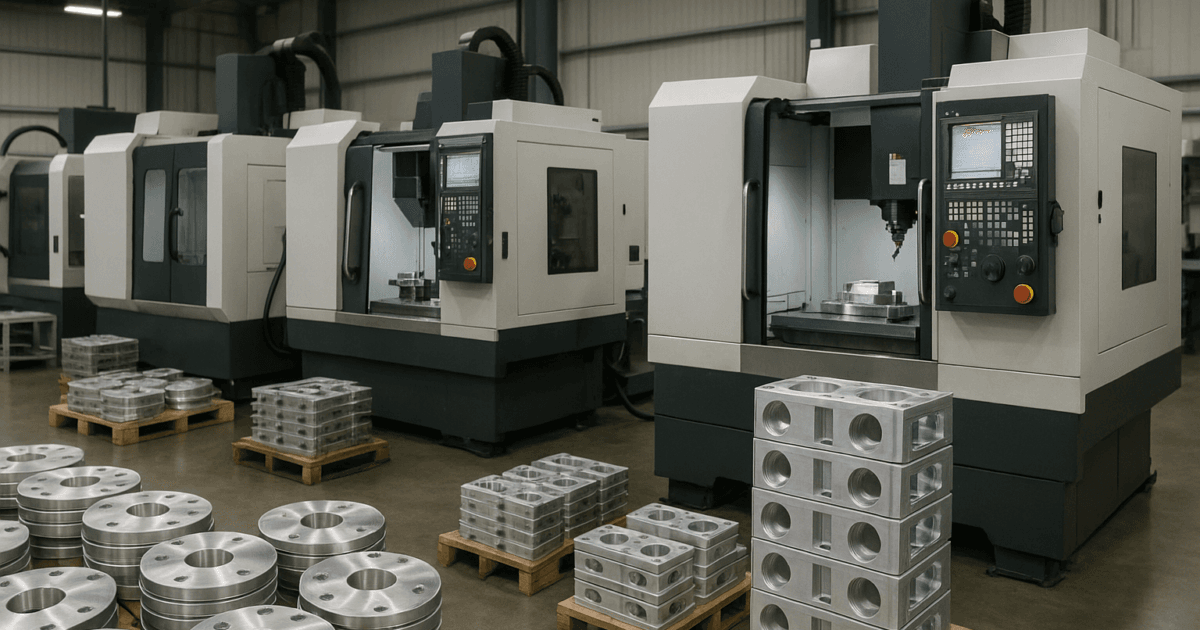
The Dutch metal and manufacturing industry is changing along two lines simultaneously: automation is taking over tasks that were previously performed manually, and sustainability is becoming an increasingly important criterion in the procurement of materials. Both developments intersect in day-to-day practice.
Accelerated automation in the metal sector
Welding robots, CNC machines, and cobots are taking over more and more tasks in the Dutch metal and manufacturing industry. This shift not only increases efficiency but also improves accuracy and safety within production lines.
For companies performing complex machining operations on materials such as aluminum, the use of CNC machines has become a prerequisite for meeting the demand for high-quality products. Automation is therefore less a cost-saving measure than an entry requirement for certain contracts.
Aluminum in advanced technologies
Aluminium plays a role in applications that extend far beyond classical mechanical engineering. An example is the use of aluminium and titanium in ultra-high vacuum and extreme high vacuum chambers for quantum computing. These chambers provide the cryogenic environment necessary for the stability of qubits.
The properties that make aluminium suitable for this are the same as those that make it attractive in mechanical engineering: low weight, corrosion resistance, and good thermal properties. For this reason, Aluminium 6061-T6 remains a widely used choice.
Sustainability data in aluminium procurement
When purchasing aluminium, companies no longer weigh only the quality of the profile, but also the origin and the environmental impact of the production process. Suppliers who can transparently share their sustainability data have a concrete advantage as a result.
In today's market, it is no longer sufficient to supply only high-quality materials. Sustainability has become part of the value proposition, and that requires substantiation rather than mere intentions.
Material innovation and additive manufacturing
Material innovations show how far the playing field extends. Basalt fiber composites, for example, are used for the production of military ship hulls: lighter and stronger, with a more favorable environmental profile than traditional alternatives.
Development continues in additive manufacturing as well, with introductions such as the Fuse X1 from Formlabs. Additive manufacturing offers geometric freedom and can save costs, but requires a careful balance between design freedom, costs, and consistency. This balance differs for each part and cannot be established as a general rule.
Monk Machining provides CNC production services that are technologically advanced and environmentally conscious. We are happy to work with you to determine the material selection and machining strategy that suits your application.