
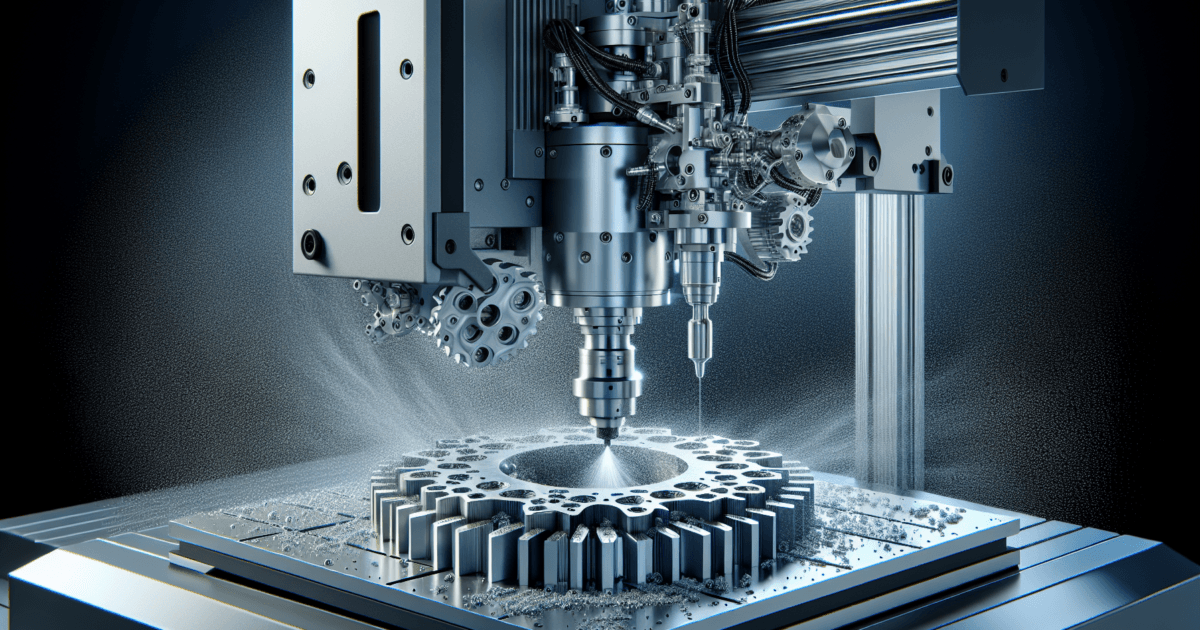
A number of developments in CNC production and aluminium technology directly impact the daily practice of machine builders and product developers: more accurate robots, an expanded aluminium market, and AI that is changing material management. We list them below.
Precision milling with industrial robots
Together with Siemens and Fraunhofer IFAM, Weiss Spindeltechnologie has developed a precision milling robot that enables industrial robots to mill with greater accuracy. This shifts the boundary between what a robot can do and what a machining center requires.
This is relevant for companies that want to increase their efficiency without sacrificing precision. Robots are more flexible to set up and cheaper to purchase than a full-fledged machining center, but until now, their applicability has been limited for machining operations where accuracy counts.
Expansion of aluminium capacity by Alcoa
Aluminium remains an essential material in numerous industrial applications. Alcoa, one of the world's largest producers, has announced it will expand aluminium capacity. This decision was made to mitigate supply chain disruptions caused by war.
The expansion enables Alcoa to better respond to rising demand and offers customers greater stability in their supply chains. For OEM suppliers who depend on a reliable flow of materials, that continuity is often more important than the bare material price.
AI in material classification
AI technology is also changing the way materials and components are classified. This is particularly important in asset-intensive industries, where incorrect classification can result in significant costs further down the process.
By implementing AI-driven classification systems, companies can accelerate their product design cycles and manage materials more accurately. The gain lies less in speed than in preventing errors that only become visible late in the chain.
3D printing and material optimization
Bambu Lab has introduced the X2D dual-nozzle 3D printer, aimed at minimizing post-processing and material waste. At the same time, the company has phased out the X1 series, making room for technologies that better align with current market demand.
For OEMs and system integrators, this primarily means that prototypes can be realized faster and with less waste, which shortens the lead time of a design process.
At Monk Machining, we closely follow innovations in CNC technology and aluminium production. Our team is happy to assist you in integrating these technologies into your production processes.